What leveling typically costs near Fletcher
Fletcher's valley floor between Asheville NC and Hendersonville sits on ground that looks easy but doesn't hold position year over year. Most manufactured homes here were installed with standard concrete block piers on gravel pads, and that system absorbs several seasons of clay movement before it shows. When it shows, the first question is what fixing it costs.
Most re-leveling work in the area falls into the ranges below. A full line-item breakdown is in the NC mobile home leveling cost guide.
| Job scope | Typical range |
|---|---|
| Light re-level — shimming a few piers (single-wide) | $400–$700 |
| Full re-level — all piers shimmed (single-wide) | $700–$1,200 |
| Full re-level — all piers shimmed (double-wide) | $700–$2,000 |
| Partial pier and pad replacement (3–6 supports) | $2,500–$3,500 |
| Full pier and pad replacement | $3,500–$5,000 |
The top of the replacement range applies when multiple concrete pads have sunk, cracked, or tilted enough to require a full reset on compacted fill. Homes that have been shimmed twice or more — common on valley lots in the corridor where mobile homes were planted through the 1990s — often cross from the re-level tier into replacement, because shimming over a compromised pad doesn't hold.
What a settling home looks like from inside and underneath
Some signs that a home has moved are immediate to the occupant. Others only appear when someone gets under the home.
Inside: doors that no longer latch without lifting the handle, windows that bind in their tracks during dry weather, floors that flex or dip toward one wall, and a countertop where water visibly pools at one end. On a double-wide, a gap or raised ridge at the marriage-wall seam where the two sections meet is a direct indicator that the halves have settled independently.
Outside: skirting that has pulled away from the bottom rail on one side, a porch step that no longer aligns with the entry, or a visible tilt when looking down the length of the home from one end.
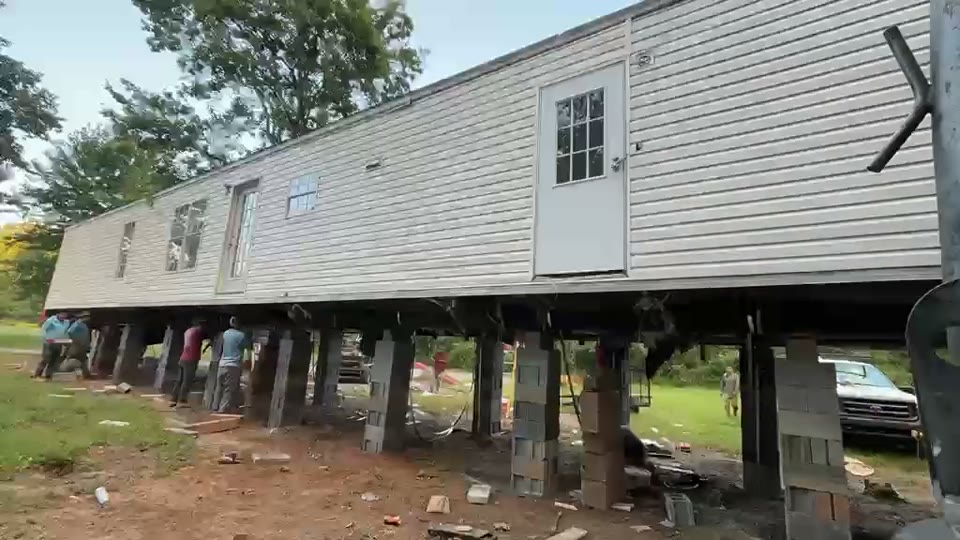
Underneath: cracked or tilted piers, pads sunk below their original position, shims that have already blown out from a previous leveling job, and wood girders pulled away from their bearing points. Blown-out shims are the clearest indicator that the pad below has moved past the point where shimming will produce a durable result. What a thorough inspection covers — and what to expect from the visit — is detailed on the mobile home re-leveling service page.
Replacing piers versus shimming — the Henderson County calculation
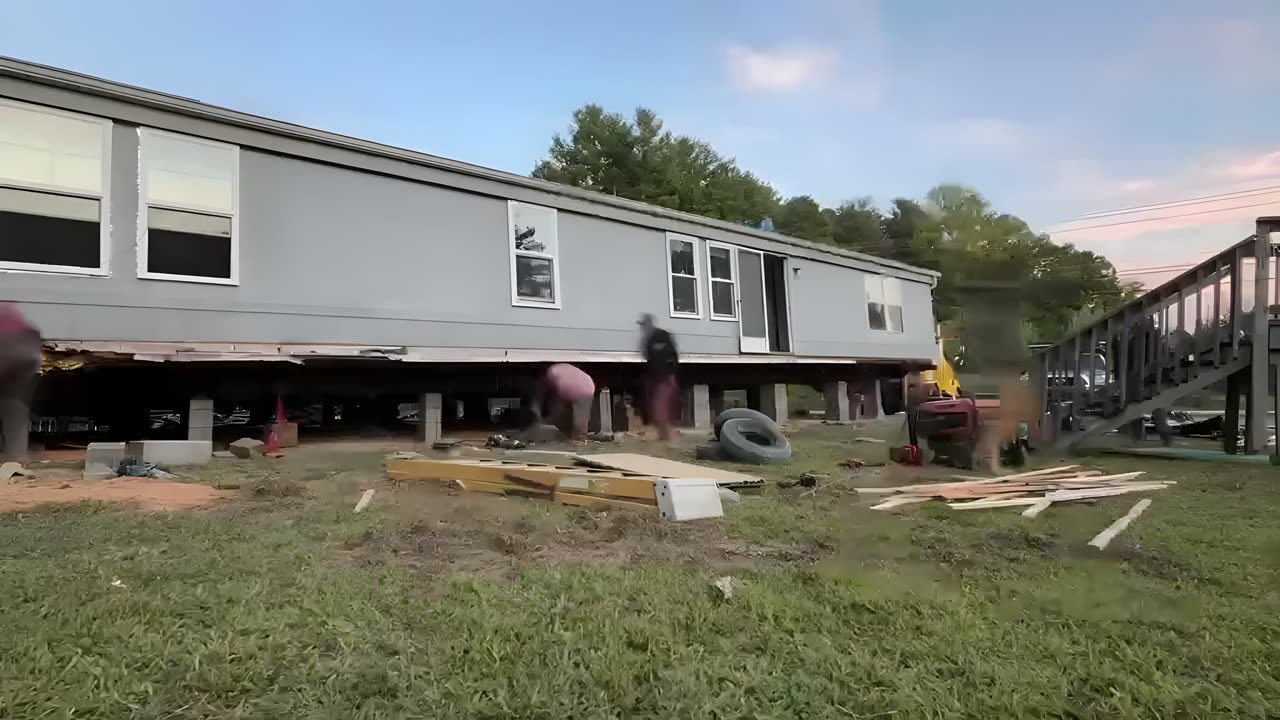
Shimming works when the pier is structurally sound and the concrete pad beneath it is still at the correct bearing depth and hasn't tilted. The crew lifts the home with hydraulic jacks, slips hardwood or composite shims to bring each pier to plumb and level, secures the shims against migration, and lowers the home back. Done right on intact pads, a full re-level holds for several years before the next clay cycle calls for adjustment.
Pier replacement is the right scope when pads have cracked or sunk, when piers have tilted beyond what shimming can correct, or when the original installation used pads undersized for the soil type. On Fletcher lots with clay-bearing subsoil, an undersized pad will continue moving regardless of how carefully the pier above it is shimmed. Replacement means pulling the old piers and pads, evaluating the soil at each location, setting new concrete pads at the correct bearing depth, and installing piers rated to the actual load of the home above.
Homes that have gone through multiple shim cycles without pad work are the most likely candidates for full replacement. Another shim on a bad pad costs nearly as much as starting fresh and holds for far less time. Cost comparisons for both scopes are in the NC leveling cost guide.
Clay soil, moisture, and what drives settlement in the valley
The Henderson County valley carries clay-bearing soils throughout the I-26 corridor from Asheville NC south through Fletcher and into Hendersonville. Clay expands when it absorbs moisture and contracts as it dries — a cycle that applies mechanical pressure to pier-and-pad foundations in both directions. A single wet winter followed by a dry summer can shift a pad a measurable fraction; repeated over years, that fraction accumulates into visible settlement.
The county's moisture history makes that cycle more damaging. Henderson County has recorded 16 federal disaster declarations over 1978-2026, including Hurricane-category events in 2019, 2020, and 2023, a Tropical Storm in 2024, and a Winter Storm declaration in 2026. Each saturation event pushed extended moisture into subsoil already under cyclical stress, and the 2026 winter freeze-thaw cycle added a concrete-degradation mechanism on top of pads that absorbed those preceding events.
Managing water around the home's perimeter matters as much as the piers themselves. Grading that moves runoff away from supports, a maintained vapor barrier under the home, and keeping pads clear of standing water all belong in any serious leveling or replacement scope. A leveled home still sitting in chronically wet ground will settle again on the same cycle.
State rules, anchoring, and what to ask before work starts
Henderson County falls in HUD Wind Zone I under 24 CFR 3280.305, the federal structural performance standard for manufactured homes. Zone I carries required minimum tie-down and anchoring specifications for every installation, and any re-leveling work that involves moving piers is a natural checkpoint for the strap-and-anchor system. Corroded straps, ground anchors lifted by saturated soil, and connections installed to an older standard than the current HUD requirement are all worth finding during the same site visit. The National Weather Service guidance on tornado safety for mobile homes identifies anchoring as the single most critical factor in a home's wind performance — and that applies in Zone I as much as anywhere else.
All manufactured home support system work in North Carolina is governed by the NC Manufactured Housing Board, which licenses installers and sets the technical standards for pier systems, tie-downs, and setup. The federal construction and safety standards that inform those requirements originate with the HUD Office of Manufactured Housing Programs. Ask any crew for their installer license before work starts; the board maintains the licensing database.
Three questions worth asking before signing off: whether the crew has replaced pads on clay-bearing soil before, what drainage work is included in the scope, and whether the anchor system will be inspected as part of the visit. A crew that separates the anchor inspection from the leveling job is creating a gap that costs more to close later. The full scope of what a proper installation involves is covered on the mobile home set-up and installation page.