What homeowners in the Asheville NC area actually pay
Mountain lots above Leicester, ridgeline sites in Swannanoa, and gravel pads on the far side of Black Mountain: mobile homes across Buncombe County sit on terrain that shifts with every wet season and every hard freeze. That movement shows up in sticky doors, sloping floors, and gaps at the marriage line of a double-wide long before the problem becomes visible from the outside. Re-leveling corrects the tilt; pier and pad replacement corrects the cause. The two jobs price differently, and knowing which one you need changes the quote substantially.
The ranges below reflect honest market conditions for western NC, a region where a single winter's freeze-thaw cycle can move a home more than a flatland pad moves in several years.
| Scope of work | Typical NC range | What drives it |
|---|---|---|
| Single-wide re-leveling (shimming) | $400 – $1,200 | pier count, access, degree of tilt |
| Double-wide re-leveling | $700 – $2,000 | marriage-line alignment, pier count, slope |
| Pier and pad replacement | $2,500 – $5,000 | block failure, soil erosion, full re-block scope |
These are starting-point market ranges, not bids. Access to the pier system, including how low the skirting clearance sits and whether the lot pitches steeply toward the home, affects labor time, and labor time is where quotes on mountain lots diverge most.
Single-wide vs. double-wide: why the price splits at the marriage line
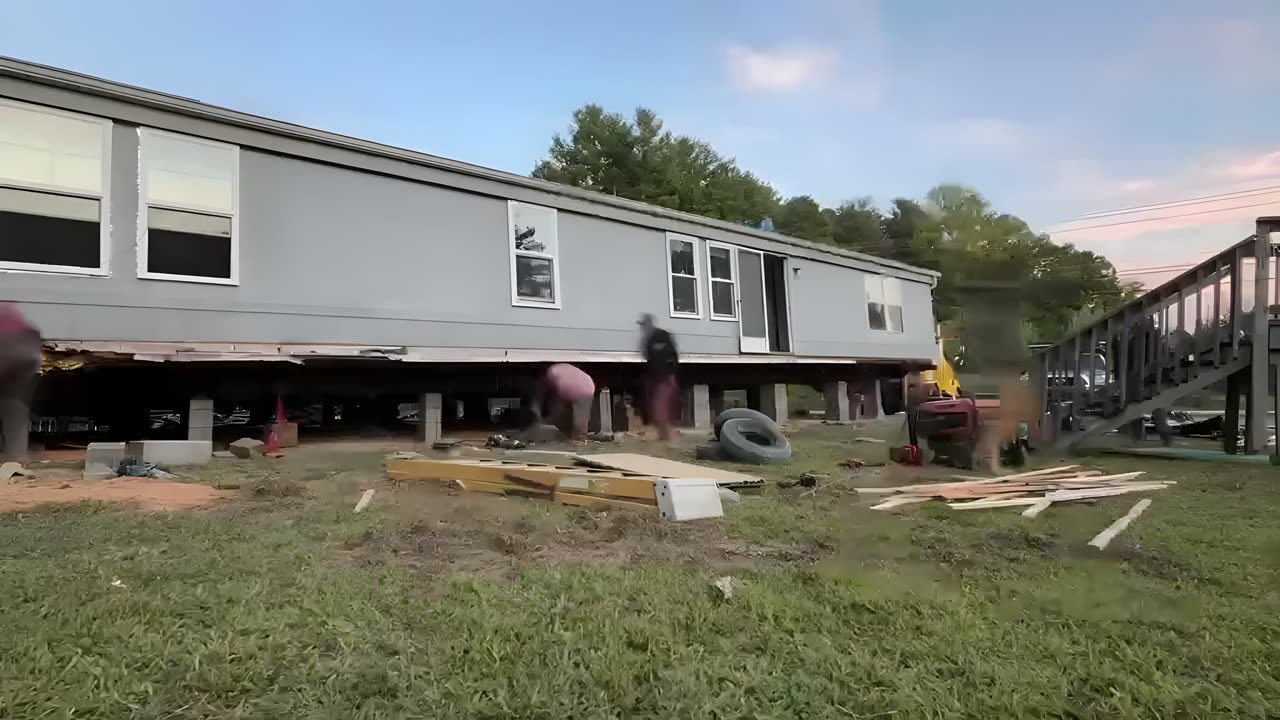
A single-wide re-level follows a straightforward sequence: position jacks under the steel chassis, bring the frame back to plumb, resize or add shims at each pier block, and verify level at multiple points across the floor. The $400 to $1,200 range mostly reflects pier count and the degree of drift. A home three degrees out of level sitting on a cracked block takes longer than one that has shifted half a degree on a solid pad, but both jobs follow the same basic pattern.
A double-wide carries a structural complication a single-wide does not. Two separate sections meet along the marriage line, and both halves must be lifted and re-leveled in a coordinated sequence. Rush the process or neglect the marriage line, and the roof ridge bows or interior ceiling panels separate at the seam. On Buncombe County's sloped lots, where one end of a home may sit noticeably lower than the other, that coordination takes more time and care. Gaps along the marriage-line ridge, sagging at the center roofline, or interior wall cracks running along the seam are signs that the two halves have drifted relative to each other. Correcting that alignment — not just leveling each half independently — is what drives a double-wide toward the upper end of the $700 to $2,000 range.
When shimming is not enough: pier and pad replacement
Shimming levels a home that has drifted; it does not fix a home whose piers have failed. Concrete block piers crack from frost heave, from point loading, and from years of mountain clay swelling and contracting through wet seasons. When a block has fractured across its bearing face or a pad has sunk into softened soil, adding shims on top of the damage pushes the problem forward. The home will need the same work again, sooner, from a worse starting position.
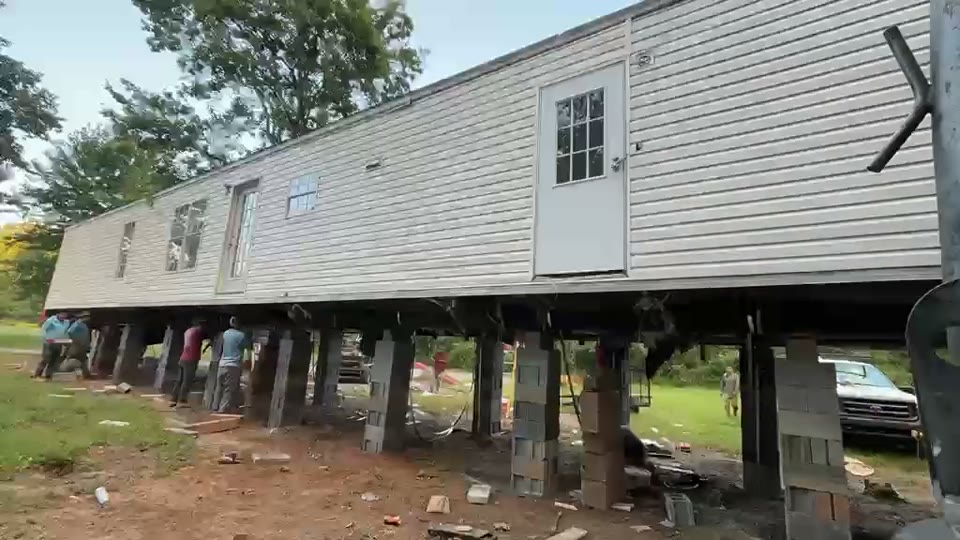
Full pier and pad replacement means pulling broken blocks, clearing soft or eroded material below the pads, setting compacted gravel bases, and re-stacking new concrete pier blocks under the chassis. For most NC mobile homes, that job runs $2,500 to $5,000. The range covers the cost of new concrete pads and blocks plus the labor time involved in working under a loaded home, particularly on a sloped site where staging equipment and repositioning take longer.
The clearest signs that suggest replacement over shimming: a pier block that rocks when you push it by hand, visible fractures running across the bearing surface, and pads that have settled unevenly so the home's weight loads one edge instead of distributing across the full surface. Our guide to grading and footers explains what the base preparation under those pads should look like before new piers go in, because how the ground was prepared at installation determines how long any re-block holds.
How storm history in Buncombe County shapes your re-check schedule
Buncombe County carries a federally documented storm record: 19 federally declared disaster events over 1973-2026. Recent declared events include a Winter Storm (2026), a Tropical Storm (2024), and Hurricanes in 2023, 2021, and 2020. Each of those events drives soil saturation and wind loading that accelerates the drift cycle on a manufactured home's pier system in ways that a flatland county does not experience to the same degree.
Unlike a site-built home on a continuous concrete footing, a manufactured home rests on individual piers. A saturated hillside pad absorbs and releases water unevenly, and individual blocks settle at different rates as the underlying soil wets and dries through the season. A home that was properly leveled after an install can show measurable drift before the following winter, not because the work was poor, but because the western NC ground cycle is more active than in flatter, drier parts of the state.
The practical re-check guidance for Buncombe County: inspect level and pier contact after any storm event that moved significant water across or under the pad, and schedule a full professional re-check every three to five years regardless of visible symptoms.
Wind is a related maintenance consideration. Buncombe County falls in HUD Wind Zone I under 24 CFR 3280.305, the federal construction and safety standard that governs how manufactured homes are engineered and installed. The National Weather Service mobile home tornado safety guidance is direct: a properly anchored home on a maintained pier system performs better in severe weather than one that has drifted and lost contact with its tie-down anchors. Leveling and anchoring inspection belong on the same maintenance schedule.
NC licensing requirements and the federal installation standard
Mobile home leveling and re-blocking in North Carolina falls under the manufactured housing installation rules administered by the NC Manufactured Housing Board, part of the Office of State Fire Marshal. State rules require that installation work, including re-leveling after initial setup, be performed by a licensed installer or under the direct supervision of one. A contractor who cannot produce a current NC manufactured housing installer license for this work is not the right contractor, regardless of price.
The federal counterpart is the HUD Office of Manufactured Housing Programs, which administers the construction and safety standards every manufactured home must meet. HUD's installation standard (24 CFR Part 3285) sets the footing size, pier capacity, and anchoring system requirements that determine whether a re-leveling job holds over time or cycles back into drift within a few seasons. Contractors who understand that standard approach the work differently than those who treat leveling as shimming and move on.
For projects that involve moving a home to a new Buncombe County site rather than re-leveling in place, the transport step and the installation step each carry their own permit process. The NCDOT oversize/overweight permit (Publication MH-2) governs the road movement; the installation permit flows through the county under NC Building Code Council standards. Our setup and installation guide maps which permit applies to which step and what the inspection sequence looks like.
Getting to a number you can trust
Three practices separate a useful re-leveling quote from one that generates change orders:
- Ask what the pier inspection includes. A crew that prices strictly by shims added, without assessing existing block and pad condition, leaves the material cost open. If a block fails after the shimming is done, you pay for the access work twice.
- For a double-wide, ask specifically about the marriage-line procedure. How the two halves are sequenced during lifting is what keeps the roof ridge and interior seam intact. A contractor who answers this question vaguely is likely to treat it as an afterthought on the job.
- Compare bids against the ranges on this page. A quote far below $400 for a single-wide almost always means shimming only, with no pad or pier evaluation included. A quote that pushes above the ranges without a clear explanation warrants a direct question about what is driving the number.
The pier system and the ground under it matter as much as the leveling itself. See the re-leveling process guide for a detailed look at what the work sequence involves, and grading and footers for what a properly prepared base looks like before the blocks ever go in.