What Buncombe County homeowners actually pay
Manufactured homes represent a meaningful portion of the housing stock across Buncombe County, from established parks along the French Broad River corridor to single-home placements on ridge-cut lots outside Asheville NC. Those sites do not settle the same way, and the quotes reflect that reality. National pricing averages you find on home-improvement aggregators are built on flatland data; the range in this county is shaped by mountain terrain, soil behavior during wet winters, and support systems that range from poured-concrete piers to stacked wooden blocking that has absorbed years of mountain-weather moisture cycles.
| Scope of work | Typical Asheville NC range | What drives it |
|---|---|---|
| Re-leveling, single-wide | $400 – $1,200 | Site slope, access, number of adjustments |
| Re-leveling, double-wide | $700 – $2,000 | Footprint size, cross-section leveling, frame condition |
| Partial pier or pad replacement | $2,500 – $3,800 | Count of failed supports, material type, site access |
| Full pier replacement | $3,800 – $5,000 | Total pier count, slope-adjusted footing depth, materials |
These are working ranges for the Asheville NC market, not a quote for any specific home. A single-wide on a level community pad with intact concrete piers sits near the low end of its range. A double-wide on a sloped parcel where wooden blocking has been absorbing seasonal moisture for years sits near the top of its range or crosses into pier-replacement territory. A contractor who quotes without walking the site is working from assumptions, not conditions.
Why slope and storm history accelerate settling
Most leveling work in Buncombe County shares the same underlying cause: water moving downhill at a rate the original installer did not fully account for. A manufactured home sited on a graded ridge lot catches uphill runoff against its low-side perimeter through every storm season, gradually undercutting blocking and softening the soil around pad footings. On flatter community sites that pattern is absent, but the county's history of high-precipitation weather events creates saturated ground conditions that accelerate pier sinking regardless of lot type.
Buncombe County has recorded 19 federally declared disaster events spanning 1973-2026. The recent sequence alone — a Winter Storm in 2026, a Tropical Storm in 2024, and Hurricanes in 2023, 2021, and 2020 — shows what repeated saturation and high-wind loads do to manufactured home supports over time. Waterlogged soil shifts. Wooden blocking that was structurally sound before a wet season can compress or crack afterward. Re-leveling calls in Buncombe County reliably spike in the months following a major storm, and inspections often uncover settling that has been building across multiple seasons, not just the most recent one.
The practical consequence for any quote: if an inspection does not assess what the supports have been through, the price given is a floor, not a ceiling. Our guide on when re-leveling becomes full pier replacement explains the physical signs that separate the two jobs.
How support type and age shape the final price
The single biggest variable inside the re-leveling range is what the crew finds underneath the home. Not all support systems age the same way, and the materials your home is currently sitting on affect both the labor time and whether the job stays within the re-leveling range or steps into pier replacement.
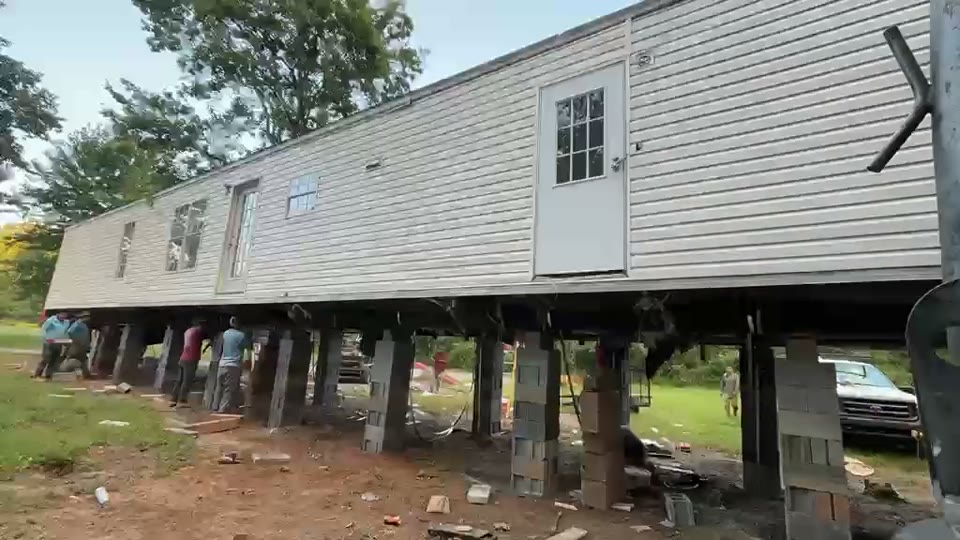
Concrete masonry piers are the standard specified under HUD manufactured housing installation guidelines and are durable through Buncombe County's freeze-thaw cycles. They can still crack or shift when the footing pad beneath them has been undermined by channeled runoff from an uphill lot. Wooden blocking, common on older installs and rural site placements across Asheville NC, absorbs moisture across seasons and can compress or soften in ways that make re-leveling a temporary fix unless the blocking itself is replaced at the same time.
Age of the home adds another layer. A home installed fifteen or twenty years ago on original wooden supports that have never been inspected is a different job scope than a newer installation on properly specified concrete piers on a dry, flat lot. An honest quote addresses support condition before any shimming price is given. A quote that skips that assessment is not a real number; it is an opener that grows once the crew gets on site.
Permits, licensing, and the wind zone requirement
Manufactured housing in North Carolina operates under a regulatory framework specifically separate from the residential building code that governs site-built homes, and that framework applies to leveling and setup work in Buncombe County the same as anywhere in the state.
The NC Manufactured Housing Board (NC Office of State Fire Marshal) licenses the contractors who install and substantially re-work manufactured homes in North Carolina. Full setup and pier replacement fall within the scope of work requiring a licensed contractor; the licensing requirement exists because improper support installation creates documented structural and safety hazards. Asking for board credentials before work begins costs nothing and immediately separates licensed operators from unverified ones working outside state oversight.
Federal standards come through the HUD Office of Manufactured Housing Programs, which sets minimum construction and installation requirements. One provision has direct bearing on every setup and re-leveling job in Buncombe County: the county is designated Wind Zone I under 24 CFR 3280.305, the standard-load wind classification. That designation governs minimum anchoring and tie-down specifications for any manufactured home installed or re-set here. A setup that does not meet Wind Zone I anchoring is out of compliance with federal installation standards regardless of what the invoice states or what the contractor says about local practice.
What to ask before any crew starts work
Three questions tend to separate a price that holds from one that grows before the job finishes in the Asheville NC market.
Ask what the pads and piers look like before they quote. The re-leveling range and the pier-replacement range cover different jobs at different prices and do not overlap. A contractor who quotes without inspecting the existing supports is building a number on assumptions. The leveling service overview covers what a thorough site evaluation includes and what it should turn up before any price is given.
Ask whether the lot drains away from the home. On sloped parcels around Asheville NC, a re-leveling job that leaves an active drainage problem in place tends to need redoing within a shorter interval. A grading correction or perimeter drain installed alongside the leveling costs more upfront and reduces re-leveling frequency over the following years.
Compare every bid against the county ranges in the table above. A bid that lands well below the range for its scope deserves an explanation — there can be real reasons, such as a short job on a flat lot with dry concrete piers, and a contractor who explains it clearly is a stronger sign than one who cannot. A bid that runs past the pier-replacement ceiling should be itemized line by line before any agreement is signed.
For context on how Asheville NC pricing compares to the rest of North Carolina, the statewide leveling cost guide puts Buncombe County's range in perspective.