What re-leveling costs in this part of Henderson County
Etowah sits in the lower valley west of Hendersonville, where French Broad River drainage shapes the terrain and the soil conditions under every pier. That geography matters for price: valley-floor lots that have absorbed storm runoff carry a higher chance of footing migration than ridge lots in the same county, pushing more jobs toward the top of the typical range. The full NC mobile home leveling cost breakdown walks through every driver; the working ranges for an Etowah job look like this:
| Scope | Typical range |
|---|---|
| Single-wide re-level, existing piers and pads sound | $400 – $1,200 |
| Double-wide re-level, existing piers and pads sound | $700 – $2,000 |
| Pier or pad replacement added to re-level | $2,500 – $5,000 |
| Full re-blocking after move or major storm settlement | Priced under setup work |
Access conditions affect labor time directly: tight skirting clearances, saturated soil under the chassis, and steep approach grades all add hours. A quote offered without a crawl inspection first is a guess at a scope that has not been seen.
Signs that a low-ground home has shifted
Mobile homes on low-ground Henderson County lots give consistent warnings before a re-level becomes urgent. Interior doors that bind on the latch side — especially in the middle sections of the home — are almost always a levelness issue rather than a door or frame problem. Floors that feel soft or bounce where they were firm, gaps opening at wall-ceiling corners, and skirting panels that buckle or pull away from the frame after fitting flush are all signs worth acting on. Seasonal variation matters here: a door that started binding after a recent storm season and has not improved is a different problem from one that sticks only in humid summers.
On a double-wide, watch the marriage wall. The center joint running the length of the home will separate at ceiling height on the low side when the two halves have shifted relative to each other. That separation means re-leveling needs to address both sections, not just the perimeter piers. If any of these signs appeared or worsened after a wet season, the timing and the cause are almost certainly the same.
What Henderson County's storm record does to bearing soil
Henderson County carries 16 federal disaster declarations on record spanning 1978-2026, most of them storm and flood events. The recent pattern is notable: Hurricanes in 2019, 2020, and 2023, a Tropical Storm in 2024, and a Winter Storm in 2026 have pushed sustained water at foundations that were built for normal seasonal drainage, not repeated saturation. Pier pads on older Etowah sites — particularly those set on native clay or uncompacted fill before current installation practices took hold — can migrate under that kind of prolonged pressure. The French Broad tributaries that cross lower Henderson County at elevations where mobile homes commonly sit funnel storm runoff directly toward the home's foundation zone, which is why valley-floor lots here settle faster and more unpredictably than their ridge-lot counterparts.
The practical result is that many re-leveling calls arrive six to eighteen months after a storm season, once the soil has dried enough to reveal the permanent shift. A preventive crawl inspection after any significant storm event costs a fraction of the job it can prevent. Where water is the underlying cause, addressing drainage before correcting level is not optional — it is the correct sequence.
How a re-level actually gets done
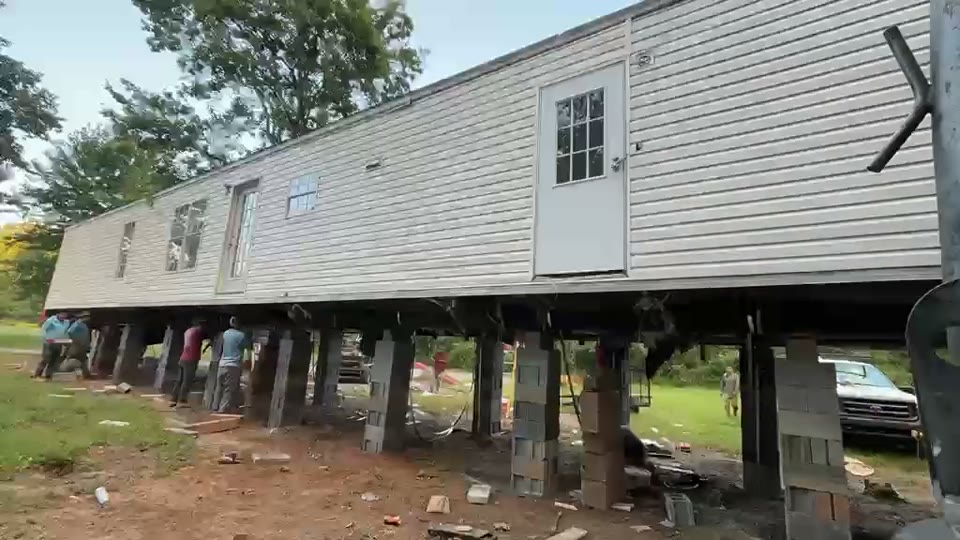
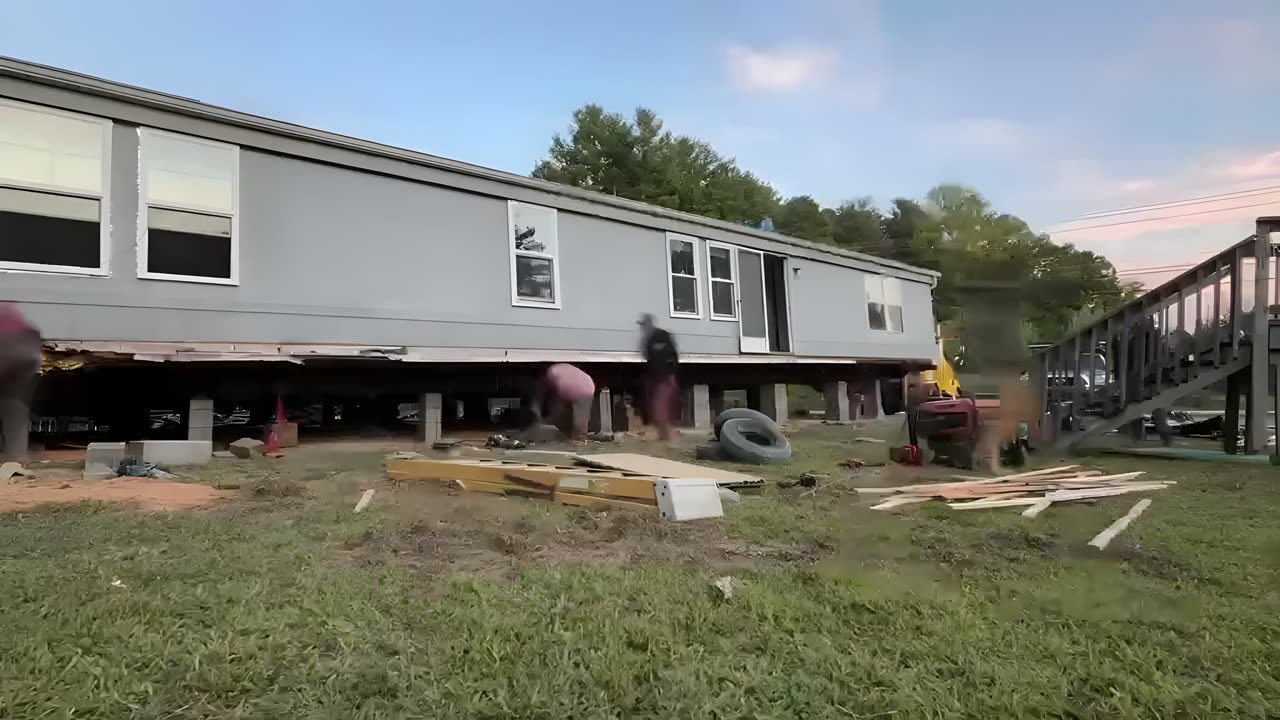
The work starts under the home, not on top of it. Every pier is checked for plumb and condition; every pad is examined for settlement, cracking, or loss of contact with the pier. On a double-wide, both halves are assessed independently before any lift begins. Hydraulic jacks raise low sections in small increments — moving fast transfers stress to wall panels, ceiling joists, and the marriage-wall connection. Shims are reset, replaced, or supplemented, and the home is walked again after the jacks come out.
The re-leveling process guide covers what the inspection should include and how to read a scope report. Homes with more than two inches of total settlement, or any rotation visible across the marriage wall on a double-wide, typically need a full re-blocking sequence rather than spot shimming — that is a different scope and a different price than a standard re-level, and it should be quoted separately.
Anchor and tie-down requirements after the work
Henderson County falls in HUD Wind Zone I under 24 CFR 3280.305 — the least severe of the three HUD-code wind designations, but not a designation that makes anchoring optional or informal. Any time a home is re-leveled after storm-related soil movement, the anchor system should be inspected alongside the piers. Straps pulled by footing migration, corroded during flood events, or simply unchecked for several years may no longer meet current standards even if they were code-compliant at original installation.
The HUD Office of Manufactured Housing Programs sets the minimum anchorage requirements that all HUD-code homes must meet. North Carolina enforces installer compliance through the NC Manufactured Housing Board, which also administers licensing and consumer complaints for manufactured housing work statewide. A re-level following a storm event is a natural checkpoint to confirm that anchor count, condition, and tensioning still meet both standards — skipping that check is a missed opportunity.
What to ask before you hire in Etowah
When this crew extended service from Transylvania County into the Etowah corridor, the job mix looked different from ridge-lot work in adjacent counties: softer soil profiles, tighter crawl clearances on older homes, and more post-storm settlement patterns than dry-season drift. That difference should shape the questions you ask any re-leveling contractor. Has the crew worked the specific pier system under your home? Steel H-frame pads and poured concrete footings fail differently and require different correction. How do they handle work after a wet season — do they schedule around drainage, or push forward regardless? And does their scope include an anchor inspection, or does that require a separate call?
In North Carolina, manufactured housing installer licensing flows through the NC Manufactured Housing Board. Asking how a contractor's qualifications apply to your specific job scope is a straightforward question that any experienced crew should be able to answer directly before work begins.